

Ports in Iran play a vital role in international trade and regional transit. Iran has more than 20 commercial ports, but six of them handle almost all international cargo: Shahid Rajaee Port (Bandar Abbas), Imam Khomeini Port, Chabahar Port, Bushehr Port, Amirabad Port, and Bandar Anzali. Together, these ports connect the Persian Gulf, the Gulf of Oman, and the Caspian Sea, giving Iran a unique position as a land bridge between Asia, the Middle East, the CIS region, and Europe.
For traders moving goods through the International North-South Transport Corridor (INSTC) or looking for alternatives to longer sea routes, understanding which ports in Iran are best suited for different types of cargo is the first step toward a smooth and cost-effective shipment.
A Quick Note on Current Shipping Conditions:
Shipping conditions in the Persian Gulf and the Strait of Hormuz can shift quickly due to regional developments. In 2026, periods of heightened tension have affected vessel schedules and transit through the Strait at different points in the year.
This does not change the underlying strengths of Iran's port network, but it does mean that route planning, vessel bookings, and transit timing should always be confirmed against current conditions before cargo moves. Working with a forwarder who tracks these changes daily, rather than relying on static information, is the safest way to avoid delays.
Why Ports in Iran Matter for International Trade
Iran sits between two very different trade regions:
- To the south, the Persian Gulf and the Gulf of Oman connect to global shipping lanes used by carriers from the UAE, India, China, and beyond.
- To the north, the Caspian Sea links Iran to Russia, Kazakhstan, Turkmenistan, and the wider CIS market.
This geography makes Iran a natural transit country for cargo that needs to move between Asia and Europe without going through longer maritime routes. The INSTC uses this position directly, combining sea, rail, and road legs through Iran to cut transit time between India, Russia, and Central Asia compared to the traditional route through the Suez Canal.
For foreign traders, this means ports in Iran are not only entry or exit points for goods staying inside the country. Many shipments simply pass through Iran on their way to Afghanistan, Central Asia, the Caucasus, or Russia.
Major Iranian ports map:
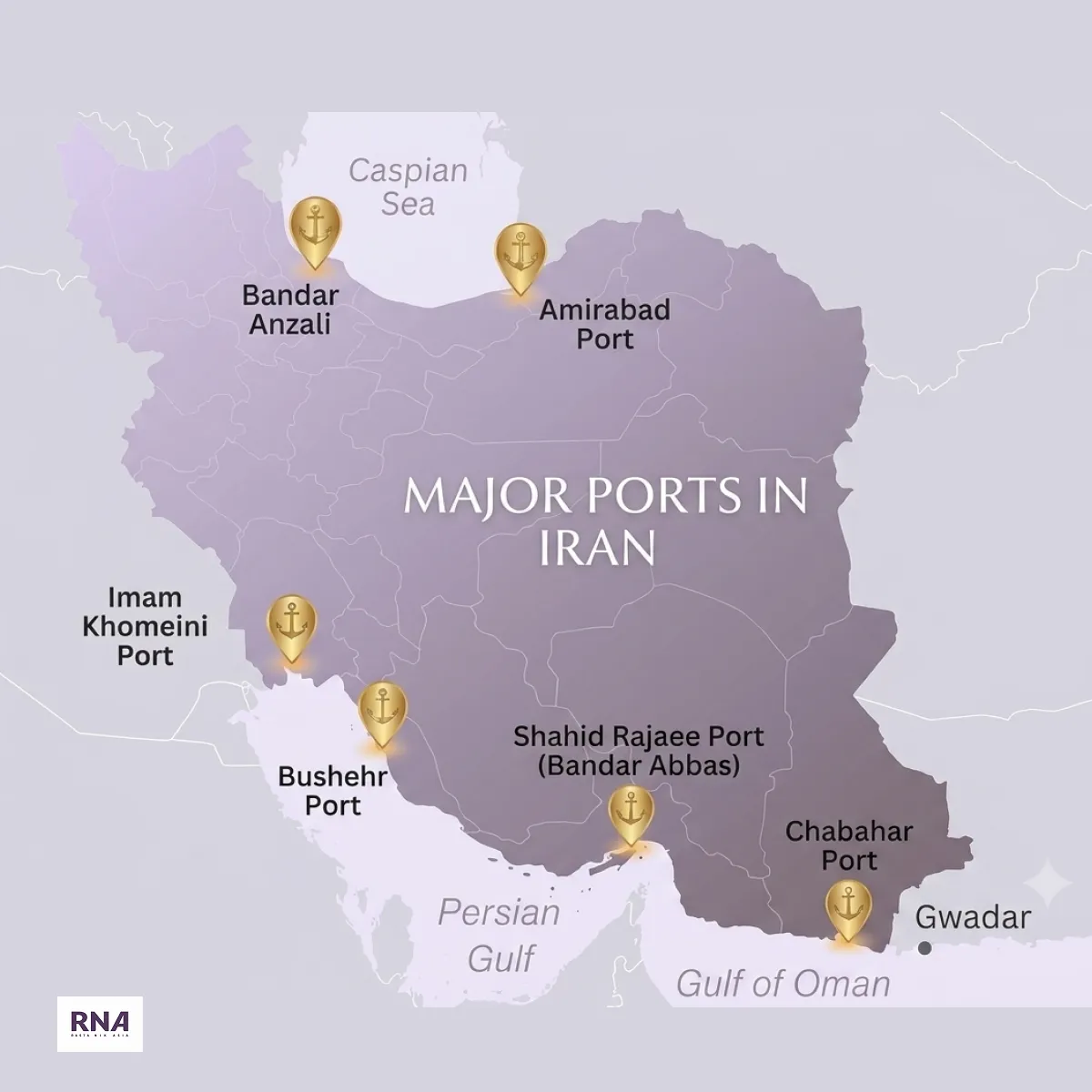 Shahid Rajaee Port (Bandar Abbas)
Shahid Rajaee Port, part of the larger Bandar Abbas port complex, is Iran's busiest container terminal and its main gateway to the Persian Gulf and international shipping lines.
Location: North shore of the Strait of Hormuz, Hormozgan province.
Key facts about Shahid Rajaee Port in Iran
- Covers about 2,400 hectares with more than 40 berths.
- Handles the large majority of Iran's containerized trade.
- Container throughput reached roughly 2.4 million TEU in 2024, with nominal capacity considerably higher after recent equipment and terminal upgrades.
- Deep-water berths accommodate large modern container vessels.
- Directly linked to Iran's national rail network, supporting onward transit toward the Caspian Sea and Central Asia.
Shahid Rajaee is one of the main ports in Iran and is good for: Full container loads, general cargo, and shipments that need connections to a wide range of international shipping lines. Because Shahid Rajaee is the primary southern terminal for the western branch of the INSTC, it is often the first stop for cargo entering Iran from the UAE, India, or East Asia.
Imam Khomeini Port
Imam Khomeini Port is one of the main ports in Iran and is located in Khuzestan province near the Iraqi border. This port is Iran's main hub for bulk and liquid cargo.
Location: Northwestern Persian Gulf, on the Khor Musa waterway.
Key facts about Imam Khomeini Port in Iran
- One of Iran's largest ports by land area, with more than 30 berths.
- Deep-water access supports large bulk carriers.
- Positioned next to major petrochemical and industrial zones.
- Handles a significant share of Iran's non-oil bulk cargo, including grain, fertilizer, sulfur, and iron ore.
Imam Khomeini Port is good for: Bulk commodities, petrochemicals, and industrial raw materials. Traders exporting or importing grain, edible oils, or chemical products often route through this port because of its specialized bulk-handling infrastructure.
Chabahar Port
Chabahar is Iran's only ocean port, sitting directly on the Gulf of Oman rather than inside the Persian Gulf.
Location: Sistan and Baluchestan province, southeastern Iran.
Key facts about Chabahar Port in Iran:
- Bypasses the Strait of Hormuz entirely, which can be an advantage during periods of congestion or heightened security concern in the strait.
- Developed in phases, with the Shahid Beheshti terminal built to support container and multipurpose cargo.
- Serves as a corridor connecting India to Afghanistan and Central Asia without transiting Pakistan.
- Rail connectivity to the national network is still developing, so road transport currently plays a larger role for inland cargo movement.
Chabahar Port is another one of the main ports in Iran and is good for: Cargo moving between India, Afghanistan, and Central Asia, and for shippers who want a route that avoids the Strait of Hormuz. Chabahar has also been a focus of Indian infrastructure investment, reflecting its strategic role in regional connectivity.
Bushehr Port
Bushehr is one of the main ports in Iran, located in the central Persian Gulf.
Location: Bushehr province, central Persian Gulf coast.
Key facts about Bushehr Port:
- Long-established trading port with general cargo, oil-related shipments, and industrial goods.
- Smaller container capacity than Shahid Rajaee, making it a secondary rather than primary container hub.
- Useful for regional trade within the Persian Gulf.
Bushehr Port is good for general cargo and regional Gulf trade, particularly for shippers looking for an alternative to the busier terminals at Bandar Abbas.
Amirabad Port
Amirabad is Iran's largest port on the Caspian Sea and a key link in the northern leg of the INSTC.
Location: Mazandaran province, Caspian Sea coast.
Key facts about Amirabad Port:
- The only northern Iranian port fully integrated with the national rail network.
- Handles containers, dry bulk, Ro-Ro, and oil-related cargo.
- Includes the Amirabad Special Economic Zone, supporting industrial and logistics activity.
- Direct connectivity supports onward trade with Russia, Kazakhstan, and other Caspian states.
Amirabad is one of the main ports in Iran and is good for: Cargo continuing north toward Russia and the CIS region after entering Iran through a southern port. Rail integration makes Amirabad a strong choice for multimodal shipments.
Bandar Anzali
Bandar Anzali is another major Caspian Sea port, located in Gilan province.
Location: Northwestern Iran, Caspian Sea coast.
Key facts about Bandar Anzali port in Iran:
- Direct access to the national railway network.
- Important trade link with Russia and other Caspian coastal countries.
- Handles containers and general cargo alongside Amirabad, giving northern Iran two strong Caspian gateways.
Bandar Anzali is good for: Trade with Russia and northern CIS markets, especially when combined with a southern entry point as part of a full INSTC route.
Comparing Major Ports in Iran
The following table provides a quick comparison of the main ports in Iran used for international shipments. Each port serves different trade routes, cargo types, and logistics needs. Whether you're shipping containers, bulk commodities, or project cargo, understanding the strengths of each port can help you choose the most efficient gateway for your supply chain.
| Port | Sea/Coast | Main Cargo | Key Advantage |
| Shahid Rajaee (Bandar Abbas) | Persian Gulf | Containers, general cargo | Largest capacity, most shipping lines |
| Imam Khomeini | Persian Gulf | Bulk, petrochemicals | Deep water, industrial zone access |
| Chabahar | Gulf of Oman | Containers, multipurpose | Bypasses Strait of Hormuz |
| Bushehr | Persian Gulf | General cargo, oil-related | Regional Gulf trade |
| Amirabad | Caspian Sea | Containers, dry bulk, Ro-Ro | Rail-linked, INSTC north |
| Bandar Anzali | Caspian Sea | Containers, general cargo | Direct link to Russia |
How to Choose the Right Iranian Port for Your Shipment
The right port depends on more than location. Consider these factors before booking a route:
- Cargo type: Bulk and petrochemical shipments usually move through Imam Khomeini Port, while containerized goods generally go through Shahid Rajaee.
- Final destination: If your cargo is headed to Central Asia or Russia, a route combining a southern port with Amirabad or Bandar Anzali often makes sense.
- Route sensitivity: If you need to avoid the Strait of Hormuz, Chabahar offers a direct alternative through the Gulf of Oman.
- Transit time versus infrastructure: Rail-linked ports like Shahid Rajaee and Amirabad support faster onward movement than ports still relying mainly on road transport.
- Current conditions: Vessel schedules, port congestion, and regional security conditions can change. Confirm the current status with your forwarder before finalizing a route.
Expert tip: For multimodal shipments using the INSTC, pairing Shahid Rajaee Port in the south with Amirabad Port in the north creates one of the most efficient rail-connected routes currently available through Iran.
Customs, Transit, and Compliance Considerations
Moving cargo through Iran involves specific customs and compliance steps that differ from many other transit countries.
- Customs clearance in Iran runs through the national customs administration (IRICA), with electronic processing handled via the Sabtaresh registration system for import declarations.
- Incoterms should be agreed clearly in contracts, since responsibility for customs clearance, insurance, and transport costs shifts depending on the terms used (for example, FOB, CIF, or DAP).
- Cargo insurance matters for any shipment passing through multiple transport modes. Common policy types include Total Loss (TL), Free of Particular Average (FPA), With Average (WA), and Institute Cargo Clauses A / All Risks, each offering a different level of coverage.
- Sanctions-related compliance is an area where documentation and payment structures need extra care. Traders should review applicable clauses with their compliance team or legal advisor before finalizing contracts involving Iranian transit.
Because these requirements can change, working with a forwarder in Iran who has direct representatives at ports in Iran and up-to-date knowledge of customs procedures reduces the risk of delays significantly.
Final Thoughts
Major ports in Iran give international traders more route options than many people expect. Shahid Rajaee handles the volume, Imam Khomeini specializes in bulk, Chabahar offers a path around the Strait of Hormuz, and the Caspian ports open a direct line to Russia and Central Asia. The right combination depends on your cargo, your destination, and how closely you can track current conditions along the route.
A logistics partner with local representatives, transparent tracking, and strong relationships across these ports can make the difference between a shipment that moves smoothly and one that gets stuck in avoidable delays.
Need help choosing the right port in Iran for your shipment? Our logistics specialists can evaluate your cargo, destination, and transit requirements to recommend the most efficient shipping route. Contact Rasta Nik Asia today to discuss your international shipping needs and receive a tailored logistics solution.