

International trade is full of opportunities, but it also comes with challenges. One of the most important steps for any trader or merchant working with the Iranian market is customs clearance in Iran. If your goods face issues during customs, your entire supply chain can be delayed.
This guide will explain everything you need to know about the process, requirements, costs, and best practices for customs clearance in Iran. Whether you ship food, livestock, or industrial goods, it will help you plan better and avoid unnecessary risks.
Customs clearance in Iran is the official process that allows goods to legally enter, leave, or cross the country. It includes document checks, HS code classification, inspection, payment of duties and taxes, and a customs release order.
Why Customs Clearance in Iran Matters
Customs clearance in Iran is the official process that allows imported or exported goods to legally enter or leave the country. Without completing this step, no shipment can move forward.
For foreign traders, it is especially important because:
- It ensures your cargo complies with Iranian trade laws.
- It prevents delays, fines, or seizure of goods.
- It reduces unexpected costs and complications at the borders.
- It allows you to build trust with your local partners and clients.
If you ship sensitive goods, such as food products or livestock, correct documents are even more important.
In our daily work with traders from CIS countries, India, China, Turkey, and the UAE, we often see the same pattern. Most delays do not come from customs itself. They come from small paperwork errors made before the cargo leaves its origin
Import Clearance vs. Transit Clearance in Iran
Many foreign traders do not realize that there are two different types of customs clearance in Iran, and understanding the difference can save you a lot of time.
1- Import clearance
Import clearance applies when goods are entering Iran as their final destination. The importer must pay all applicable duties and taxes before the cargo is released into the Iranian market.
2- Transit clearance
Transit clearance applies when goods are only passing through Iran on their way to another country, for example, from the Persian Gulf ports to Uzbekistan, Turkmenistan, or Afghanistan. In this case, the cargo does not enter the Iranian market, but it still needs to go through an official customs process at the point of entry and exit.
| Import clearance | Transit clearance | |
| Final destination | Iran | Another country |
| Enters Iranian market? | Yes | No |
| Duties and taxes | Paid before release | Usually not paid if goods leave Iran under customs control (a guarantee may be required) |
| Main risks | Wrong HS code, missing licence | Broken seals, missing exit documents, delays |
Many road shipments move under the TIR system or an Iranian transit declaration. The cargo stays sealed and under customs control until it leaves Iran.
For companies moving cargo between the Gulf region and Central Asia, transit through Iran is often a fast and cost-effective route. Iran's location makes it a natural bridge between these two regions.
Key Authorities Involved in Customs Clearance in Iran
Several agencies manage customs clearance in Iran. Based on the type of goods, these agencies can be:
- Iran Customs Administration (IRICA): The main authority for customs procedures.
- Ministry of Industry, Mine and Trade: Approves import licenses for industrial and commercial goods.
- Ministry of Agriculture Jihad: Oversees livestock, meat, seeds, and other agricultural products.
- Ministry of Health and Medical Education: Controls imports related to food safety and pharmaceuticals.
- Standard Organization of Iran (ISIRI): Ensures imported goods meet local quality standards.
Working with a professional logistics company can help you manage these different agencies efficiently. Contact us for more information about Iran's customs clearance process.
Main Entry Points for Customs Clearance in Iran
Where your cargo enters Iran also affects your clearance process. The most important entry points in Iran include:
- Bandar Abbas Port (Shahid Rajaee Terminal): The largest and busiest port in Iran, located on the Persian Gulf. Most sea freight from the UAE, India, and China enters through here.
- Bandar Imam Khomeini: Another major southern port handling bulk cargo and container cargo.
- Dogharoun and Milak border crossings: Key land borders used for cargo moving between Iran and Afghanistan.
- Incheh Borun and Sarakhs: Border crossings connecting Iran with Turkmenistan and the broader CIS region.
- Bazargan: The main border crossing between Iran and Turkey, used heavily for road freight.
Knowing the right entry point for your cargo can reduce transit time and simplify the clearance process.
Step-by-Step Process of Customs Clearance in Iran
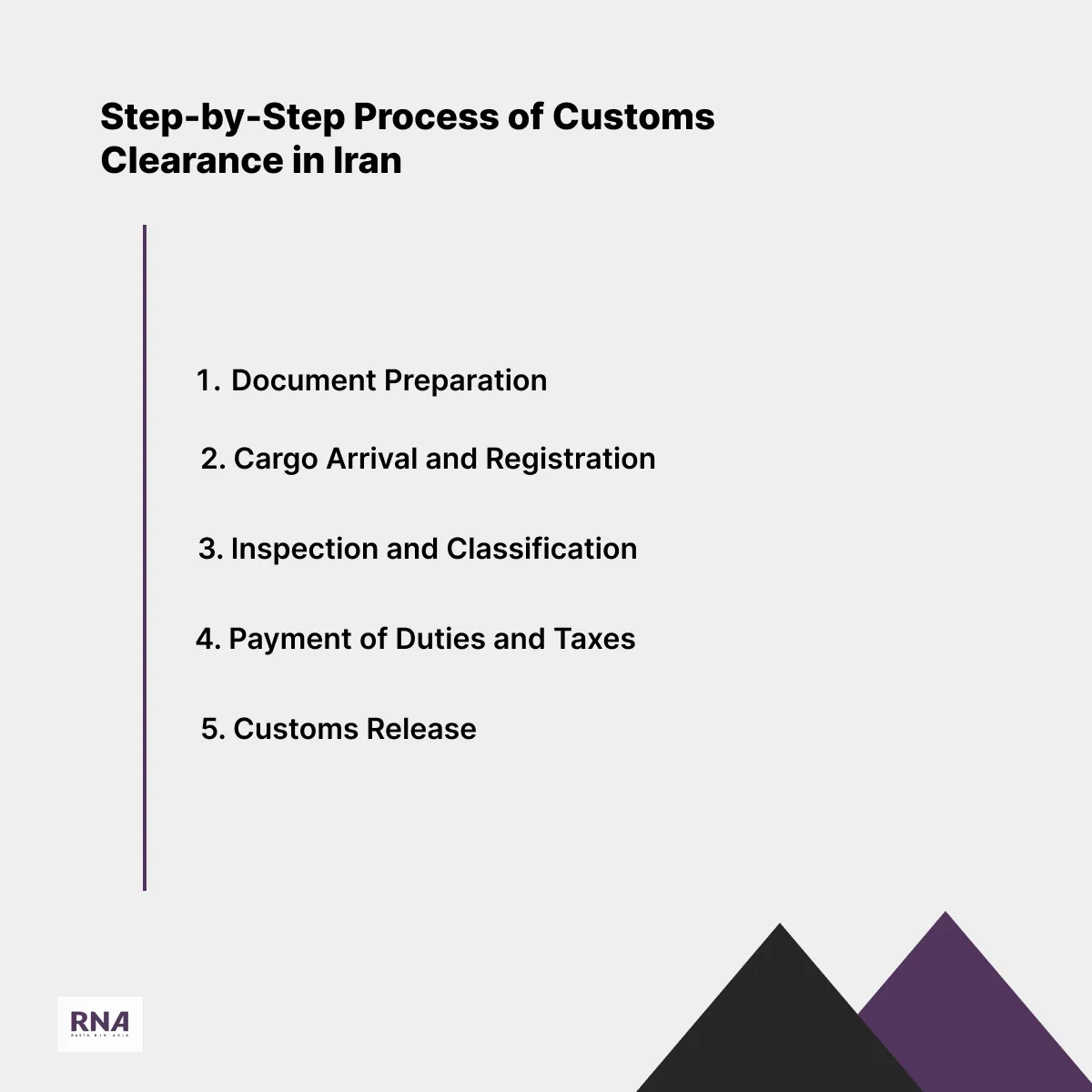
The process of customs clearance in Iran involves several official steps that every shipment must go through before it can legally move into or out of the country. Understanding these stages helps traders avoid delays and freight forwarding mistakes.
Before you ship, confirm that the importer is registered, that any needed licence or Sabtaresh registration is in place, and that the HS code is correct. Mistakes found after arrival cost much more to fix.
1. Document Preparation
Before your cargo arrives, make sure all paperwork and Iran customs documents are complete and accurate. Essential freight documents in Iran include:
- Commercial invoice
- Packing list
- Bill of lading or CMR/SMGS waybill, or airway bill
- Certificate of origin
- Import license (if required)
- Insurance documents
- Health or phytosanitary certificates for agricultural goods
2. Cargo Arrival and Registration
When your cargo arrives at an Iranian port, airport, or land border, it gets registered with customs and receives a unique code. This registration is the first official step in the clearance process.
3. Inspection and Classification
Customs officers inspect the shipment and classify it based on the Harmonized System (HS Code). This classification decides which duties, taxes, or restrictions apply to your cargo.
4. Payment of Duties and Taxes
All import duties, VAT, and other relevant charges must be paid. Rates depend on the type of product, its declared value, and any trade agreements between Iran and your country.
5. Customs Release
After inspection and payment, customs issues a release order. Your goods can now enter the Iranian market or continue in transit to another country.
How Long Does Customs Clearance Take in Iran?
This is one of the most common questions from foreign traders. The answer depends on several factors:
- Standard shipments with complete documentation are typically cleared within 3 to 7 working days at major ports like Bandar Abbas.
- Transit shipments passing through Iran can sometimes be processed faster if all paperwork is in order.
- Agricultural goods, food products, and livestock usually take longer due to additional inspections, sometimes 7 to 14 days.
- Incomplete documents are the most common reason for delays. A single missing certificate can add weeks to the process.
These are typical ranges, not guarantees. Port congestion, regulation changes, and inspection type can all change the timeline. A local representative who follows up with customs officers every day can significantly reduce waiting time.
Challenges Traders Face with Customs Clearance in Iran
While the process of customs clearance may seem straightforward, many traders face challenges like:
- Complex paperwork: Missing one document can delay your shipment for weeks.
- Language barrier: Most procedures are conducted in Farsi, creating challenges for foreign traders.
- Changing regulations: Rules may change with little notice, especially for sensitive goods like food or livestock.
- Inspection delays: Ports can get crowded, and physical inspections often take time.
- Payment and banking limits: International banking restrictions can complicate payments. Agree on the payment method and who pays duties before you ship.
- Rejection risk: In some cases, customs may reject a shipment if goods do not meet Iranian standards or if documentation is incorrect. In these situations, the goods may need to be re-exported or corrected before re-entry.
This is why many traders prefer to work with experienced logistics companies that understand local procedures and can act quickly when problems arise.
Common Mistakes in Customs Clearance in Iran That Delay Cargo
Most delays are avoidable. Watch out for these mistakes:
- Using the wrong HS code
- Declaring a value that does not match the invoice
- Names, weights, or quantities that differ between documents
- Missing health, veterinary, or phytosanitary certificates
- Unclear Incoterms, so no one knows who handles clearance
- No named consignee or local contact at the border
Tips to Simplify Customs Clearance in Iran
Here are some practical ways to make customs clearance and shipping products through Iran easier for you:
- Work with a local representative: Having someone in Iran who knows the system helps you avoid mistakes.
- Prepare documents in advance: Always check that invoices, licenses, and certificates are accurate before your cargo departs.
- Agree on Incoterms: Be clear about who handles export clearance, import clearance, and costs.
- Choose reliable partners: Not all customs brokers or transport companies have the same level of experience. Select one with a proven track record.
- Track your shipment: Ask for regular updates so you always know the exact status of your cargo.
- Use bonded warehouses: If there are delays in clearance, bonded warehouses allow you to store goods temporarily without paying duties immediately.
At Rasta Nik Asia, we provide step-by-step guidance and reporting, so our clients always know where their goods are in the process. To learn more about how you can track your shipments with us, call us today or send us an email.
Customs Clearance in Iran for Different Types of Goods
Customs Clearance for Food Products
Food shipments must follow strict health and safety controls. Importers need to provide health certificates and get approval from the Ministry of Health. Inspections are detailed to make sure the products meet Iranian food safety standards before they are released.
Customs Clearance for Livestock and Agricultural Goods
For agricultural goods, livestock, seeds, and related items, veterinary or phytosanitary certificates are mandatory. These shipments are carefully reviewed by the Ministry of Agriculture Jihad to prevent diseases and protect local farming.
Customs Clearance for Industrial Goods and Machinery
Industrial equipment, spare parts, and heavy machinery require import licenses and must meet Iranian technical standards. Because documentation errors are common in this category, it is important to double-check all papers to avoid costly delays.
Costs Involved in Customs Clearance in Iran
The cost of customs clearance depends on the type and value of your goods. You should prepare for:
- Import duties: calculated as a percentage based on the HS Code of your product
- Value Added Tax (VAT): currently 9% on most goods in Iran
- Customs service fees: charged by IRICA for processing
- Inspection and certification fees: vary by product category
- Storage charges: apply if clearance is delayed and goods remain at the port or terminal
- Agent and broker fees: charged by your local partner for handling the process.
Knowing these costs early helps you manage your budget. Always ask your logistics partner for a full cost estimate before the shipment departs.
Learn more: Freight Charges & Freight Fees in Iran
How Rasta Nik Asia Helps with Customs Clearance in Iran
At Rasta Nik Asia, we specialise in helping foreign traders from CIS countries, India, China, Turkey, the UAE, and beyond. Our team has direct experience managing customs procedures at all major Iranian borders and ports, including Bandar Abbas, Bazargan, Dogharoun, and the Turkmenistan border crossings.
Our services include:
- 24/7 availability: We are always reachable for updates, even outside business hours.
- English communication: We handle all coordination in English, so there is no language barrier for our international clients.
- Detailed reporting: Clients receive clear, simple updates about their shipments at every stage.
- Strong local presence: Our agents are active at every major Iranian border, port, and airport.
- Problem-solving: If an issue arises during clearance, we find the fastest and most effective solution.
By handling the customs clearance in Iran professionally, we let you focus on your trade without worrying about logistics. Contact us today, and our team at Rasta Nik Asia will guide you through every step of the clearance process with speed, transparency, and reliability.
Conclusion
Customs clearance in Iran is a crucial step for any international trader. With the right preparation, correct documents, and a reliable local partner, you can avoid delays and keep your supply chain running smoothly.
At Rasta Nik Asia, we provide reliable customs clearance and freight forwarding services to make your trading experience in Iran stress-free. Contact our team today to discuss your shipment and get a tailored solution for your business.
Resources
Customs Clearance Explained Step by Step