

If you ship cargo between India, Iran, Russia, or Central Asia, you have probably heard of the International North-South Transport Corridor (INSTC). The INSTC is a multimodal freight network that connects South Asia with Iran, Russia, the Caspian region, and parts of Europe through a combination of sea, rail, and road transport.
This guide explains what the International North-South Transport Corridor is, how its routes work, which countries take part, and what the corridor actually looks like for shippers in 2026, including the parts that still cause delays.
What Is the International North-South Transport Corridor (INSTC)?
The International North-South Transport Corridor (INSTC) is a 7,200-kilometer multimodal transport network connecting India, Iran, Russia, and Europe. The INSTC was established through an intergovernmental agreement signed in St. Petersburg on September 12, 2000, initially involving India, Iran, and Russia.
The goal of the INSTC is to give traders an alternative to the long sea voyage around Europe through the Suez Canal. Instead, cargo moves north through Iran by ship, rail, and road, crosses or skirts the Caspian Sea, and continues into Russia and onward to Northern Europe.
For companies moving goods between South Asia and Eurasia, the corridor is not a future concept. It is an active trade route, with tens of millions of tons of cargo already moving through it every year.
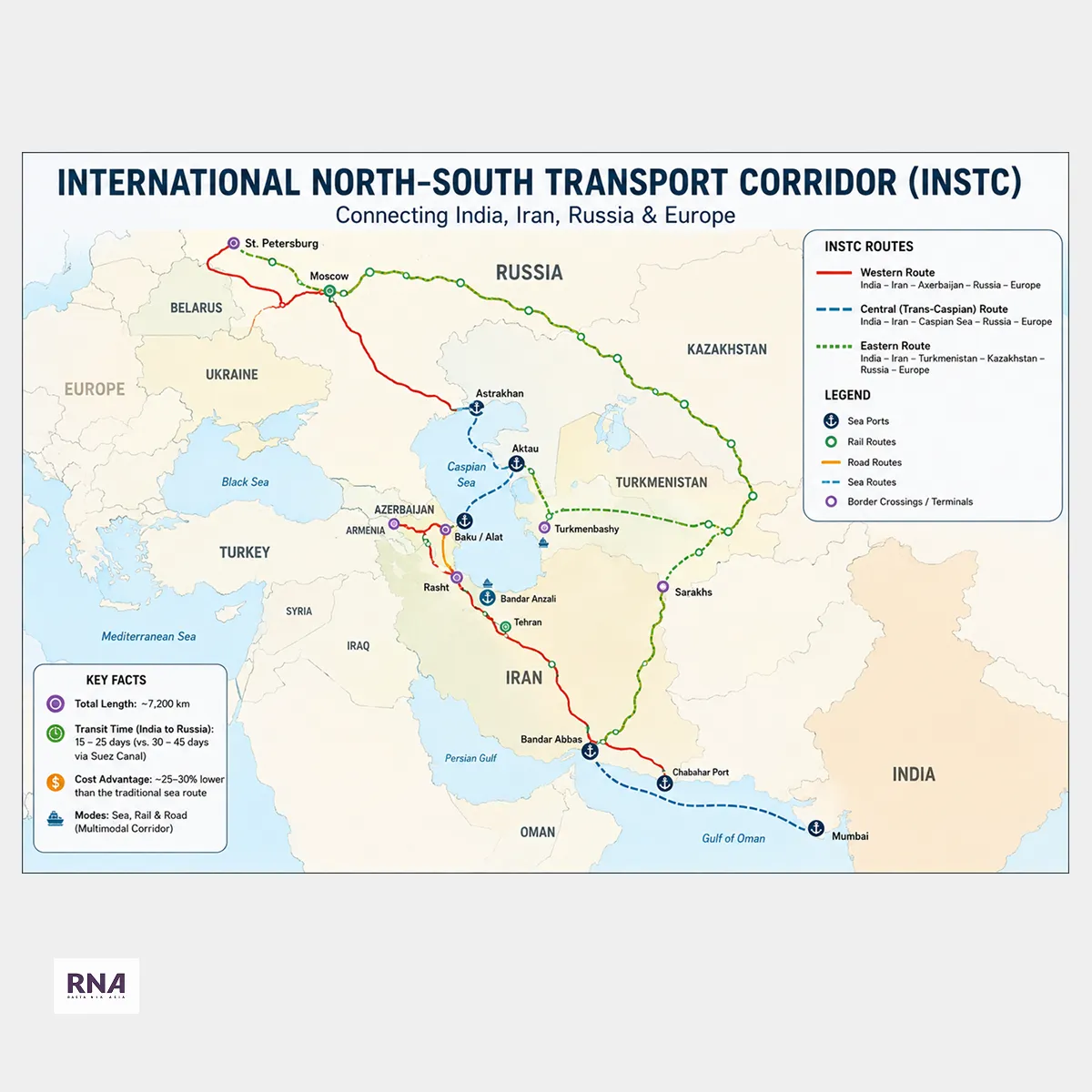
INSTC Route Map: From India to Russia and Central Asia
The INSTC connects India with Russia and Central Asia through multiple multimodal routes across Iran:
 Why the INSTC Matters for International Trade
The corridor exists to solve a real logistics problem: the traditional maritime route between India and Russia, via the Suez Canal and around Europe, is long, expensive, and exposed to congestion at global chokepoints.
The INSTC offers three practical advantages:
- Shorter transit time: Cargo moving via the INSTC can reach Russia from India in roughly 15 to 25 days, compared with 30 to 45 days on the all-water Suez route.
- Lower freight costs: Freight-forwarder trials have reported savings of around 25–30% on total shipping cost per container compared to the maritime alternative.
- Route diversification: For shippers who don't want all their cargo dependent on a single sea lane, the INSTC is a genuine second option and not a replacement for maritime shipping, but a parallel channel.
This is also why trade volume on the corridor keeps climbing. Russian authorities reported around 26.9 million tons of cargo moved through the INSTC in 2024, a roughly 19% increase year-on-year, driven largely by growing India-Russia trade.
How Much Does It Cost to Ship via the INSTC?
There is no fixed INSTC shipping cost, as freight rates depend on the complete route and shipment requirements. Key factors include:
- Origin and destination
- Cargo type and volume
- Container size
- Transport mode
- Number of transshipments
- Port handling and customs clearance
- Inland trucking and rail costs
- Caspian Sea crossing
- Insurance, storage, and demurrage
Because the INSTC is a multimodal transport corridor, freight costs should be calculated based on the complete door-to-door route rather than a single ocean freight rate.
How Does the INSTC Route Work: Iran as the Central Hub
Every version of the INSTC route passes through Iran. This is the detail most general explainers skip, and it is the most important one for anyone actually planning a shipment.
Cargo typically starts at an Indian port, most often Mumbai, and moves by sea to a southern Iranian port, which usually is Bandar Abbas (Shahid Rajaee Port) or Chabahar Port. From there, it needs to cross Iran overland or by a second sea leg to reach the Caspian Sea, before continuing into Russia.
Because there isn't one single road or rail line that does this job, the INSTC is actually three separate branches, and the branch you use changes your route, your transit time, and your risk profile.
The Three INSTC Branches
|
Branch |
Route |
Current Status (2026) |
| Western branch | Bandar Abbas → north through Iran → Azerbaijan → Russia (rail and road) | Highest cargo volume, but not fully rail-connected. A 162 km rail gap between Rasht and Astara means cargo still switches to road for part of the journey. |
| Central (Trans-Caspian) branch | Bandar Abbas or Anzali → sea crossing of the Caspian → Astrakhan, Russia | Flexible fallback route. No rail gap, but capacity depends on Caspian port throughput and vessel availability. |
| Eastern branch | Iran → Turkmenistan → Kazakhstan → Russia (rail) | Fully operational rail line since 2014. The most predictable of the three branches for scheduled transit. |
Practical takeaway: if you need reliability today, the eastern branch through Turkmenistan and Kazakhstan is currently one of the more operationally mature options for rail-based transit through Central Asia, but actual transit reliability depends on cargo type, border conditions, available rail capacity, and the final destination.
How Cargo Moves Through Iran on the INSTC
Cargo typically moves through Iran in the following stages:
- Arrival at a Southern Port: Shipments from India and other markets usually enter Iran through Bandar Abbas or Chabahar.
- Customs Clearance and Inland Transport: After port procedures, cargo continues by road or rail toward northern Iran or a Caspian port.
- Selection of the INSTC Route:
Western Route: Through Azerbaijan toward Russia
Trans-Caspian Route: From Bandar Anzali across the Caspian Sea to Russia or Kazakhstan
Eastern Route: Through Turkmenistan and Kazakhstan toward Russia and Central Asia - Border and Transit Procedures: Cargo may change transport modes, cross borders, and undergo additional customs procedures.
- Final Delivery: The shipment continues to its destination through the selected international route.
Because the INSTC involves multiple transport modes and border crossings, experienced freight forwarders can help coordinate road, rail, sea, customs clearance, and transit operations in Iran.
The Rasht-Astara Railway: The Corridor's Missing Link
The single biggest unfinished piece of the INSTC is the Rasht-Astara railway, a 162-kilometer rail line in northern Iran that would connect Iran's rail network directly to Azerbaijan's, closing the last gap in the western branch.
Without it, freight on the western branch has to leave the train, move by truck around the gap, and reload onto rail again, which adds cost, time, and handling risk to every shipment.
As of mid-2026, the project has moved from planning into active preparation:
- Land acquisition along the route has been substantially completed.
- Engineering and survey work has resumed following a pause caused by regional conflict earlier in the year.
- Russia has committed roughly €1.6 billion toward construction, with an expected build time of around 48 months once work begins in full.
For now, treat Rasht-Astara as under construction, not operational. Any shipment plan that assumes a finished rail line through this section will run into real delays.
INSTC Member Countries
The INSTC has expanded significantly since the original 2000 agreement. Its participating countries include India, Iran, Russia, Azerbaijan, Armenia, Belarus, Kazakhstan, Kyrgyzstan, Tajikistan, Turkey, Oman, Syria and Ukraine, while Bulgaria has observer status.
Membership has grown steadily since the corridor's founding, reflecting how many countries now see value in an overland alternative to Suez-dependent shipping.
INSTC vs. the Suez Canal Route
Shippers weighing the INSTC against the traditional maritime route usually want a direct comparison. Here is how the two compare on the metrics that matter most:
|
Factor |
INSTC (via Iran) |
Suez Canal Route |
| Typical transit time (Mumbai–Moscow) | ~15–25 days | ~30–45 days |
| Distance | ~7,200 km (multimodal) | Longer, all-sea |
| Cost | Roughly 25–30% lower per container in reported trials | Baseline maritime cost |
| Exposure to chokepoints | Depends on the branch used; the western branch has an active infrastructure gap | Exposed to Suez Canal congestion and Red Sea security risks |
| Modes involved | Sea, rail, and road (multimodal) | Almost entirely sea |
| Reliability today | Variable by branch; eastern branch most consistent | Generally scheduled, but subject to canal-specific disruption |
Neither route is universally "better." The right choice depends on cargo type, destination, timeline, and how much handling complexity a shipper is prepared to manage. If you are not sure which option fits your shipment, Contact Rasta Nik Asia for expert guidance and let us help you choose the most efficient route for your cargo.
A 2026 Reality Check: Regional Disruption and Routing Decisions
September 2026 Routing Note: This section reflects conditions as of September 2026. Given the pace of change in the region, we recommend confirming current routing conditions with your freight forwarder before finalizing a shipment plan.
Since early 2026, regional conflict has affected sea traffic through the Strait of Hormuz and southern Iranian ports at various points. This has pushed a growing share of shippers toward land and rail-based INSTC routing, particularly the eastern branch through Turkmenistan and Kazakhstan, as the more dependable option compared to relying solely on Gulf shipping lanes.
This shift has reinforced the strategic case for the INSTC: a corridor built around multiple routing options is more resilient than a single sea lane when conditions change quickly. Iranian and Russian authorities have both confirmed that INSTC infrastructure work, including the Rasht-Astara project, has continued through this period rather than being abandoned.
For traders, the practical lesson is this: build routing flexibility into your logistics plan. A freight partner who can move cargo across all three INSTC branches is more valuable than one committed to a single fixed route.
Documents Required for INSTC Shipments
Shipping cargo through the INSTC requires accurate documentation at different stages of the journey. Depending on the origin, destination, cargo type, and transport mode, the required documents may include:
- Commercial Invoice
- Packing List
- Bill of Lading or other transport document
- Certificate of Origin
- Customs Declaration
- Transit Documentation
- Cargo Insurance Documents
- Special Permits for restricted or specialized cargo
To learn more about the main documents required for shipping and transit through Iran, see our complete guide to Key Freight Documents in Iran.
Ports and Crossings That Matter on the INSTC
- Bandar Abbas (Shahid Rajaee Port): Iran's main Persian Gulf gateway and the primary southern entry point for INSTC cargo
- Chabahar Port: Gulf of Oman port developed with Indian investment, offering an alternative southern entry that bypasses the Strait of Hormuz
- Bandar-e Anzali: key northern Iranian Caspian port for the trans-Caspian branch
- Astrakhan, Russia: main receiving port on the Russian side of the Caspian crossing
- Sarakhs / Incheh Boroun: Iran-Turkmenistan crossings used on the eastern branch
What Types of Cargo Can Move Through the INSTC?
The International North-South Transport Corridor (INSTC) can handle a wide range of cargo, making it a flexible option for international shippers moving goods between India, Iran, Russia, Central Asia, and Europe.
Common types of cargo shipped through the INSTC include:
- Containerized cargo: Consumer goods, manufactured products, textiles, and other general cargo transported in standard shipping containers.
- Machinery and industrial equipment: Heavy machinery, production equipment, spare parts, and other industrial goods moving between Asian, Iranian, and Eurasian markets.
- Food and agricultural products: Grains, fruits, vegetables, processed food, and other agricultural commodities that require reliable transit and appropriate handling conditions.
- Metals and metal products: Steel, aluminum, copper, and other metal products transported as containerized, bulk, or breakbulk cargo.
- Chemicals and fertilizers: Industrial chemicals and fertilizers that may require specialized handling and compliance with transport regulations.
- Dry bulk cargo: Commodities such as grain, minerals, and other unpackaged dry goods transported in large quantities.
- Breakbulk cargo: Oversized or heavy individual items, including industrial machinery, construction materials, and equipment that cannot easily be transported in standard containers.
- Dangerous goods: Certain hazardous materials can also move through the corridor, provided that applicable packaging, documentation, handling, and transport regulations are met.
Conclusion: How Rasta Nik Asia Supports INSTC Shipments Through Iran
The INSTC isn't a single booking; it's a coordinated sequence of sea, rail, and road legs, each with its own documentation and customs handling. A forwarder with agents at Iran's key border crossings and ports is what keeps a multi-leg INSTC shipment moving without gaps in visibility.
Rasta Nik Asia coordinates cargo movement through Iran across all three INSTC branches and not just one fixed route. As a transit logistics partner rather than a domestic carrier, our role is to move your cargo through Iran efficiently and hand it off cleanly at the next stage of its journey, whether that's Azerbaijan, the Caspian crossing, or Central Asia.
This means:
- Route selection based on current conditions, not a single default path
- Coordination at Iranian ports and border crossings, including Bandar Abbas, Chabahar, and the Caspian and eastern land crossings
- Transparent, real-time shipment tracking so you always know where your cargo stands
- Multimodal documentation handling, including transit permits and customs procedures specific to Iran
If your business moves cargo between India, the Gulf, Central Asia, or Russia, the INSTC is worth evaluating as part of your routing strategy. Need help choosing an INSTC route?
Rasta Nik Asia can evaluate your cargo origin, destination, cargo type, and required delivery time and recommend the most suitable route through Iran. Contact our team and let us help you choose the most efficient route
Resources
International North-South Transport Corridor (INSTC)