

Moving goods through Iran can be smooth and predictable if your freight documents are correct. For many traders from CIS countries, India, China, Turkey, and the UAE, the rules and processes inside Iran may feel unfamiliar. Missing or incorrect paperwork can lead to delays, storage fees, or even shipment rejection at borders. That is why understanding the Key Freight Documents in Iran is essential for safe and fast cargo movement.
This guide explains the freight documents in Iran that matter most for transit, import, and export. Rasta Nik Asia is an international freight forwarder and transit specialist. We handle these documents every day at Iranian ports and borders. Use this page as a practical reference, whether you ship for the first time or manage regular cargo flows.
What Are Freight Documents in Iran?
Freight documents in Iran are the official papers that describe your cargo, its value, its owner, and its route. Customs, carriers, and border officers use them to approve, track, and release your shipment.
Iranian customs is run by the Islamic Republic of Iran Customs Administration (IRICA). IRICA manages clearance, transit registration, and duty calculation at official ports and borders. Its system compares details across documents line by line. That means your papers must be complete and consistent.
Why Freight Documentation in Iran Matters
Correct and complete Freight Documentation in Iran ensures:
- Smooth cargo clearance at Iranian borders
- Fast loading and unloading at ports and terminals
- Avoiding fines and extra costs
- Minimizing miscommunication with Iranian customs
- Building trust with logistics partners and inspectors
- Reducing risks in transit corridors (especially to CIS countries)
For international traders, especially those shipping food, livestock, and industrial goods, knowing the Key Freight Documents in Iran can directly impact delivery time, customer trust, and overall profitability.
Iran's customs procedures are managed by the Islamic Republic of Iran Customs Administration (IRICA), which oversees clearance, transit registration, and duty calculation at every official border and port. Understanding how IRICA reviews your paperwork is the first step to avoiding unnecessary delays.
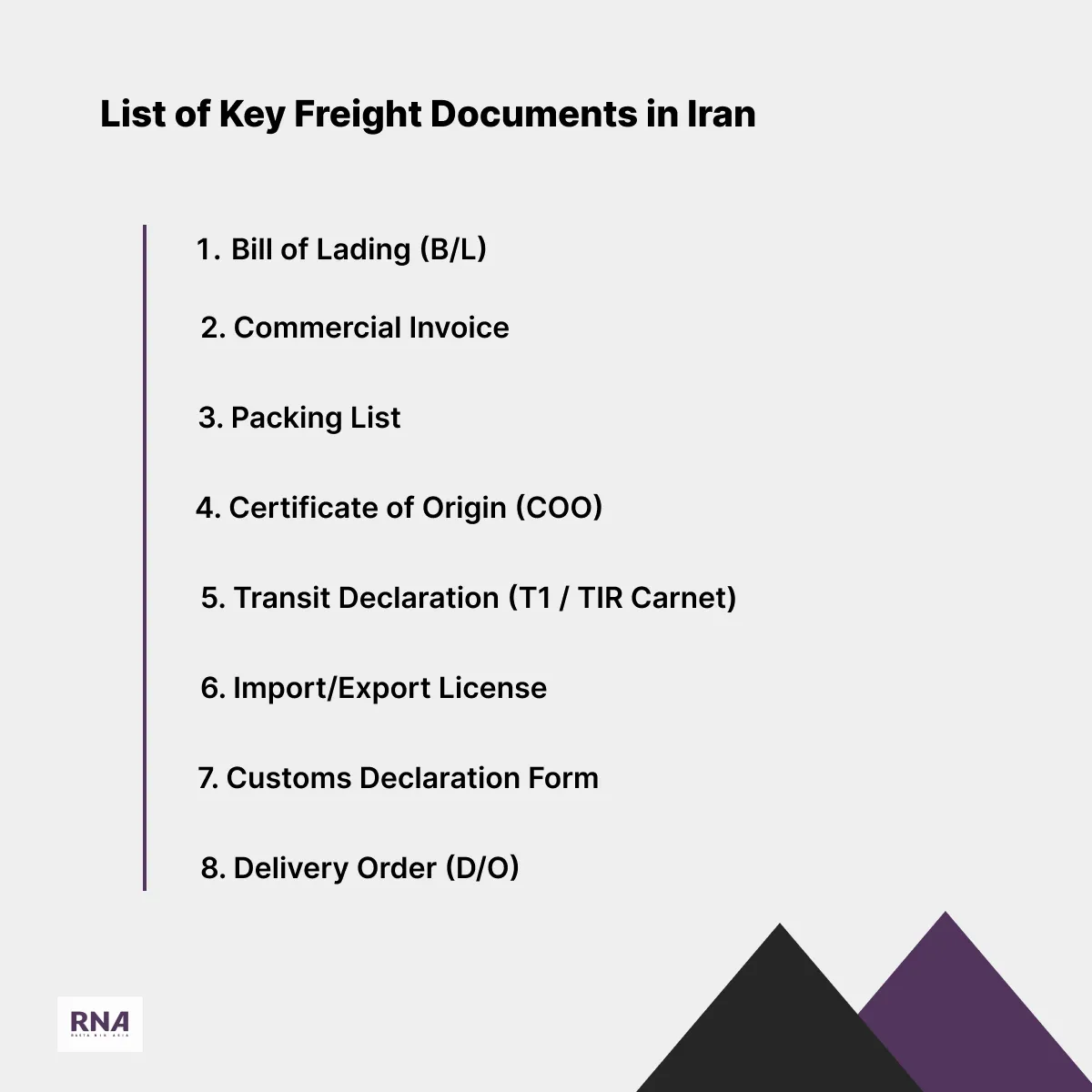
List of Key Freight Documents in Iran
Below you will find the most essential documents required for transit, import, and export operations in Iran. These documents apply to various transport methods, including air, sea, and land freight.
1. Bill of Lading (B/L)
The Bill of Lading is one of the most important Key Freight Documents in Iran. It acts as:
- Proof of shipment
- Contract between shipper and carrier
- Title of goods
In Iran, customs officers carefully check every detail on the B/L. Make sure the HS code, cargo description, and consignee name are correct. Any small error can delay Customs Clearance in Iran.
Types of B/L used in Iran
The most common types of B/L used in Iran are:
- Ocean Bill of Lading
- Air Waybill (AWB): The AWB is the transport document for air cargo. It confirms the carrier received your goods and shows the flight details. It is not a document of title.
- CMR (Road Transport Bill of Lading)
If your shipment enters Iran via road, the CMR is mandatory and is the main document used for Freight Documentation in Iran for trucks.
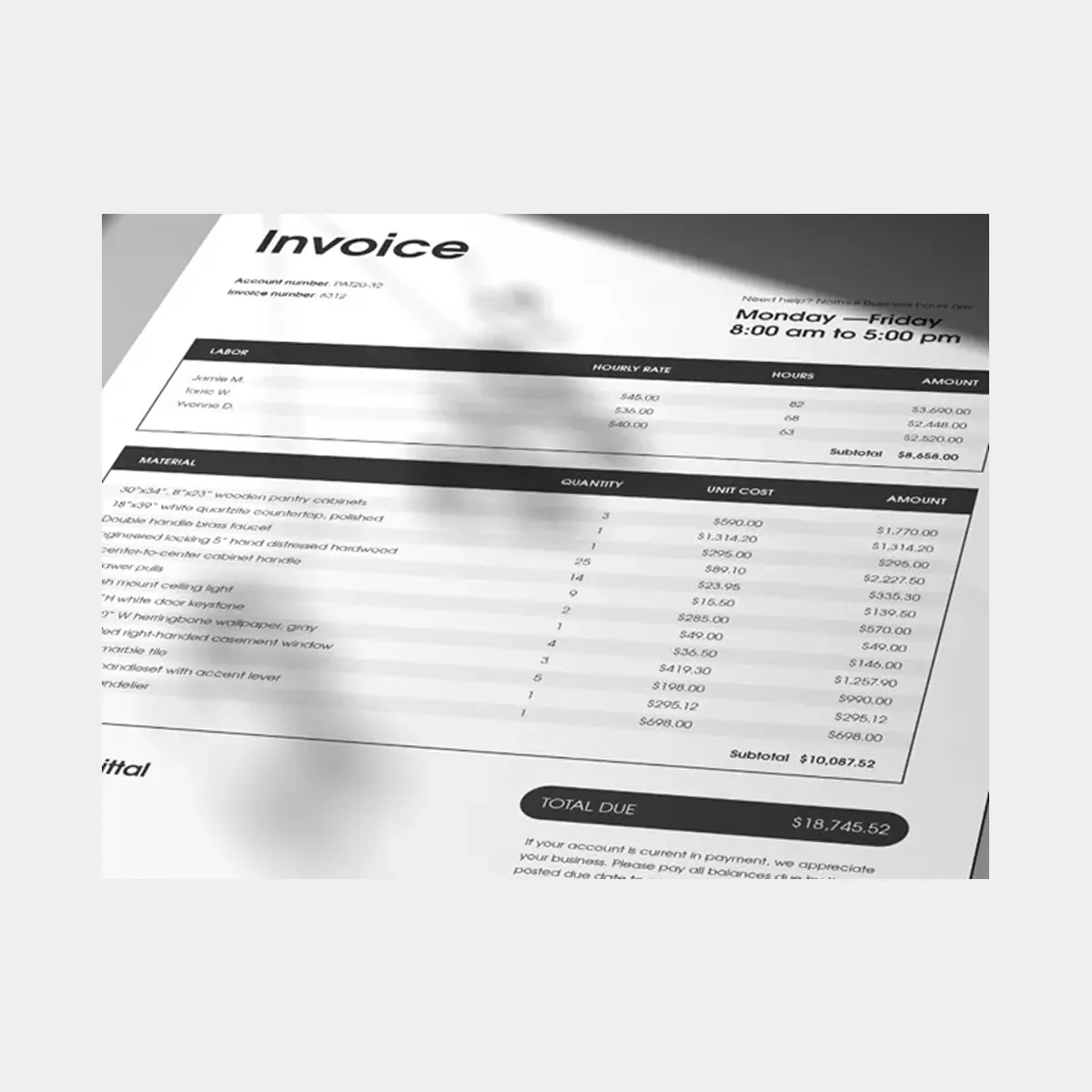
2. Commercial Invoice
The commercial invoice is a legal requirement for all shipments. Iran customs uses it to calculate customs duties, verify cargo value, and check product origin. Key elements to include are:
- Exporter and importer details
- HS code for each item
- Total value and Incoterms
- Currency (usually USD or EUR)
To avoid any issues, ensure the description matches other documents exactly. This is a core rule in Freight Documentation in Iran.
Tip: Choose your Incoterm (such as FOB, CIF, or DAP) carefully, since it determines who is responsible for freight costs, insurance, and customs duties at each stage of the journey.
 3. Packing List
A detailed packing list helps customs and warehouse teams understand what is inside each package. For many traders, especially in food or industrial materials, the packing list must include:
- Number of packages
- Gross and net weight
- Dimensions
- Type of packaging
- Batch numbers (if applicable)
This document is a key part of the Key Freight Documents in Iran because customs uses it to conduct inspections. Clear information reduces the chance of physical inspection.
4. Certificate of Origin (COO)
The Certificate of Origin confirms where the goods were produced. Many Iranian customs procedures depend on the cargo's origin. The COO is especially important for traders from China, India, Kazakhstan, Russia, Turkey, and the UAE.
Different free-trade agreements may change duty rates. That is why COO is a critical element of Freight Documentation in Iran.
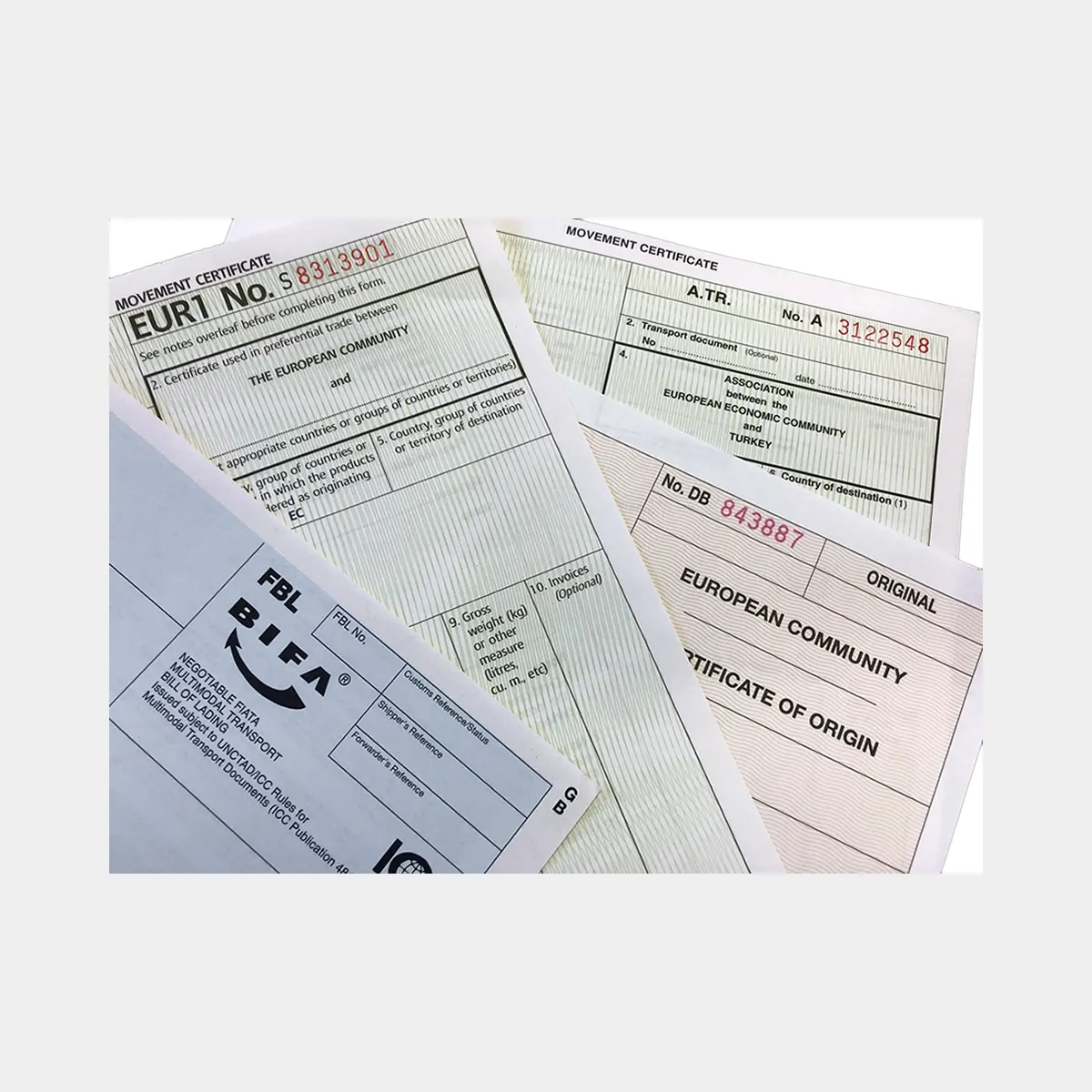 5. Transit Documents: TIR Carnet and National Transit Declaration
When your goods only pass through Iran and are not imported into the country, you must prepare a Transit Declaration. This is one of the most important elements of Freight Documentation in Iran, because it shows customs officials that your cargo is only crossing Iran on its way to another destination.
There are two main systems used:
TIR Carnet
The TIR Carnet is an international transit document used mainly for road transport. It is especially helpful for traders moving goods between Iran and CIS countries.
A TIR Carnet allows:
- Faster border crossings
- Fewer physical inspections
- Recognition of customs seals across multiple countries
- Reduced risk of delays and extra fees
For traders sending cargo to Uzbekistan, Armenia, Kazakhstan, Turkmenistan, or Azerbaijan, the TIR system is often the fastest and safest option.
National transit declaration
If cargo does not move under TIR, a transit declaration is registered in Iran’s customs system. It records:
- HS code and product description
- Route inside Iran
- Weight and number of packages
- Cargo value
- Truck and driver details
Both systems help customs track cargo from entry to exit. Errors can cause re-inspection of sealed cargo, storage fees, and confusion between customs offices.
Why These Documents Matter
Both TIR Carnet and National transit declaration help customs track and control transit cargo. When they are correct and complete, you avoid:
- Delays at borders
- Re-inspection of sealed cargo
- Storage fees and penalties
- Confusion between customs offices
Because transit is a major part of trade between Iran and its neighboring countries, ensuring accurate transit documentation is essential. Rasta Nik Asia prepares and checks these documents carefully so your cargo can move smoothly across all Iranian corridors. Call us today to get more detailed information.
6. Import/Export Licenses and Permits
Depending on the type of cargo (food products, industrial machinery, chemicals, livestock materials), you may need additional governmental permits or health certificates. Iran has strict rules on agricultural and food safety, so these licenses become central pieces of Freight Documentation in Iran.
A reliable freight forwarder understands every permit, license, and customs requirement in Iran, and guides international traders through the entire process with accuracy, speed, and full transparency. Call us today to get more information on this topic.
7. Phytosanitary and Health Certificates
If your cargo includes food, agricultural products, plants, or livestock feed, Iranian authorities will usually require a Phytosanitary Certificate or Health Certificate issued by the relevant authority in the country of origin. These certificates confirm that the goods are free from pests, disease, or contamination.
Without this certificate, agricultural and food shipments can be held at the border for inspection, or in some cases rejected. If you regularly ship perishable or agricultural cargo, it is worth preparing this certificate in advance and confirming its validity period before the goods depart.
8. Cargo Insurance Certificate
While not always mandatory by customs, a Cargo Insurance Certificate is strongly recommended for any international shipment passing through Iran. It protects traders financially against loss, theft, or damage during transit, loading, or storage.
Many buyers and financing banks also require proof of insurance before releasing payment, which makes this document part of good commercial practice as well as good risk management for your Freight Documentation in Iran.
Learn more: How to Get Cargo Insurance for Iran Shipping
9. Customs Declaration Form
When goods enter or leave Iran, a full declaration is submitted to the Iranian Customs Organization. Rasta Nik Asia prepares these declarations for traders to ensure:
- Correct HS codes
- Accurate tax calculation
- Fast processing
This form is one of the official Key Freight Documents in Iran, and errors can cause serious delays or penalties.
 10. Delivery Order (D/O)
The shipping line or airline issues the D/O. Without it, cargo cannot be released at Iranian ports such as Bandar Abbas, Bushehr, or Imam Khomeini Port. A correct D/O helps you avoid long port queues and extra storage costs.
Transit, Import, or Export: Which Documents Do You Need?
| Document | Transit | Import | Export |
| Commercial invoice | Yes | Yes | Yes |
| Packing list | Yes | Yes | Yes |
| Transport document (B/L, CMR, AWB, rail note) | Yes | Yes | Yes |
| TIR Carnet or national transit declaration | Yes | No | No |
| Customs declaration | Yes | Yes | Yes |
| Certificate of origin | Sometimes | Often | Sometimes |
| Licenses, permits, health certificates | By cargo | By cargo | By cargo |
| Cargo insurance certificate | Recommended | Recommended | Recommended |
| Delivery order (sea/air) | If applicable | Yes | No |
Requirements change by product and border. Always confirm your exact list before the cargo departs. You can contact our team to get more detailed information based on your cargo.
Freight Documents in Iran by Transport Mode
| Mode | Main transport document | Other key papers |
| Road | CMR, TIR Carnet or transit declaration | Invoice, packing list, customs declaration |
| Rail | Rail consignment note (e.g., SMGS) | Invoice, packing list, customs declaration |
| Sea | Bill of Lading, Delivery Order | Invoice, packing list, COO, insurance |
| Air | Air Waybill | Invoice, packing list, permits |
| Multimodal | Multimodal transport document | All of the above, matched across each leg |
In multimodal shipments, details must match across every leg. A change in product name between road and sea documents is a common cause of holds.
Pre-Shipment Checklist
Use these steps to check your freight documents in Iran before the cargo leaves:
- Confirm the HS code with your forwarder.
- Make sure product names match on every document.
- Check Incoterms, values, and currency on the invoice.
- Confirm all signatures and stamps are in place.
- Check expiry dates on certificates, licenses, and insurance.
- Choose the right transit system (TIR or national declaration).
- Send digital copies to your forwarder before the cargo arrives.
How Long Does Freight Documentation Processing Take in Iran?
Processing time depends on the type of shipment, the border or port used, and whether all documents are consistent and complete. As a general pattern:
- Straightforward transit shipments with a correct TIR Carnet usually move fastest, since customs seals are recognized without extensive re-inspection.
- Import shipments requiring licenses, health certificates, or standards approval typically take longer, because more than one government body may need to review the paperwork.
- Any mismatch between documents (wrong HS code, different product names, missing stamps) is the single biggest cause of extended delays.
Working with a logistics partner who checks your documents before the cargo arrives is the most effective way to keep processing time short and predictable.
Practical Tips for Smooth Documentation in Iran
- Use consistent information across all documents: In Iran, customs systems compare details line-by-line. The shipment will face delays if the HS codes and descriptions do not match.
- Prepare documents early: Send all documents to your logistics partner before cargo arrival to avoid storage costs.
- Understand regional requirements: Different borders such as Bazargan, Astara, or Dogharoun have different document expectations.
- Work with a reliable local logistics company: Rasta Nik Asia ensures your Freight Documentation in Iran meets all legal and operational requirements.
- Keep digital copies: Iran’s customs system is increasingly digital, and having PDF copies supports faster clearance.
How Rasta Nik Asia Supports Your Freight Documentation

At Rasta Nik Asia, we know that most international delays are caused by documentation problems. That is why our team:
- Reviews all Key Freight Documents in Iran before cargo arrival
- Prepares customs declarations for transit, import, and export
- Works with drivers and border offices to ensure correct CMR and TIR Carnet
- Provides real-time cargo updates
- Ensures compliance with Iranian transport laws
- Speaks English fluently and communicates clearly with foreign traders
Our team maintains direct relationships with representatives at Iran's major border crossings and ports, which means document issues can often be identified and corrected before they cause a hold-up, not after.
Our goal is to remove the stress from your supply chain so you can focus on your business and not the paperwork. You can contact us today to get more detailed information.
Benefits of Working with a Transit Specialist
- Fewer delays and lower storage costs
- One point of contact for documents and cargo
- Clear reporting you can share with your buyer
- Local knowledge of each border and port
- Fast replies when you need help
Industries We Serve
- Food and agricultural products
- Livestock feed and animal products
- Industrial machinery and equipment
- Chemicals and raw materials
- Construction materials
- Consumer goods and retail cargo
Common Mistakes Traders Make (and How to Avoid Them)
Some of the common mistakes that traders make when it comes to freight documents in Iran are:
- Incorrect HS Codes: Incorrect classification can delay cargo for days. Always check HS codes with your logistics partner.
- Missing Signatures or Stamps: Iran customs still requires physical stamps on some documents. Make sure everything is signed properly.
- Using Different Product Names Across Documents: If your invoice says "vegetable oil" but the packing list says "edible oil," customs may stop the shipment.
- Expired Certificates: Phytosanitary certificates, insurance documents, and some licenses have limited validity. Confirm expiry dates before the cargo departs.
- Choosing the Wrong Transit System: Using a T1 declaration when a TIR Carnet would have been faster (or vice versa) can add unnecessary time and cost to your route.
Avoiding these mistakes ensures smoother Freight Documentation in Iran every time.
Conclusion
Understanding the Key Freight Documents in Iran is essential for fast, reliable, and cost-effective cargo movement. Whether you ship food products, industrial equipment, livestock feed, or consumer goods, proper paperwork protects your business from delays and financial risks.
Rasta Nik Asia is ready to support you with accurate, transparent, and professional logistics services across all Iranian corridors. Need help preparing your Freight Documentation in Iran? Contact Rasta Nik Asia for fast and reliable logistics support.
Resources
Key Freight Shipping Documents For International Shipping
Key Freight Documents Explained