
Every shipment that crosses a border starts with one question: what kind of cargo is this? The answer decides almost everything that happens next: which vessel or truck it travels on, how it is packed, what paperwork it needs, and how much the shipment will cost.
Understanding the main cargo classifications in international transport helps traders, importers, and exporters avoid delays, reduce damage claims, and choose the right freight forwarder for the job.
In this guide, we break down every major cargo category used in global freight forwarding today, explain how each one is handled, and show how classification shapes routing decisions, including cargo moving through transit corridors like Iran.
What Cargo Classification Means (And Why It Matters)
Cargo classification is the process of grouping goods by their physical form, handling requirements, and risk level. Freight forwarders and carriers use these categories to decide:
- Which vessel, wagon, container, or truck type the cargo needs
- How the goods should be packed, labeled, and documented
- What safety, customs, or insurance rules apply
- How much space, time, and specialized equipment the shipment requires
Cargo is generally classified along three overlapping lines: physical state (solid, liquid, or gas), handling method (loose bulk, unitized, or containerized), and risk profile (standard, hazardous, perishable, high-value, or oversized). A single shipment can sit in more than one category; for example, a chemical product can be both liquid bulk cargo and hazardous cargo at the same time.
The Main Cargo Classifications in International Transport
Most international shipments fall into one of eight core classifications. The table below gives a quick overview before we look at each type in detail.
| Classification | Defining Feature | Typical Goods |
|---|---|---|
| Break bulk cargo | Packaged goods handled individually | Cartons, pallets, bagged goods, machinery parts |
| Dry bulk cargo | Unpackaged solids moved loose in volume | Grain, coal, ore, cement, fertilizer |
| Liquid bulk cargo | Unpackaged liquids or gases | Crude oil, fuel, chemicals, vegetable oil |
| Containerized cargo | Goods loaded into standard ISO containers | Consumer goods, electronics, textiles |
| Hazardous cargo | Poses a risk to health, safety, or environment | Chemicals, batteries, flammable liquids |
| Perishable cargo | Loses quality quickly without control | Meat, dairy, produce, pharmaceuticals |
| High-value cargo | High financial value relative to size | Electronics, branded goods, medical devices |
| Oversized cargo | Exceeds standard container dimensions | Turbines, generators, industrial machinery |
1. Break Bulk Cargo
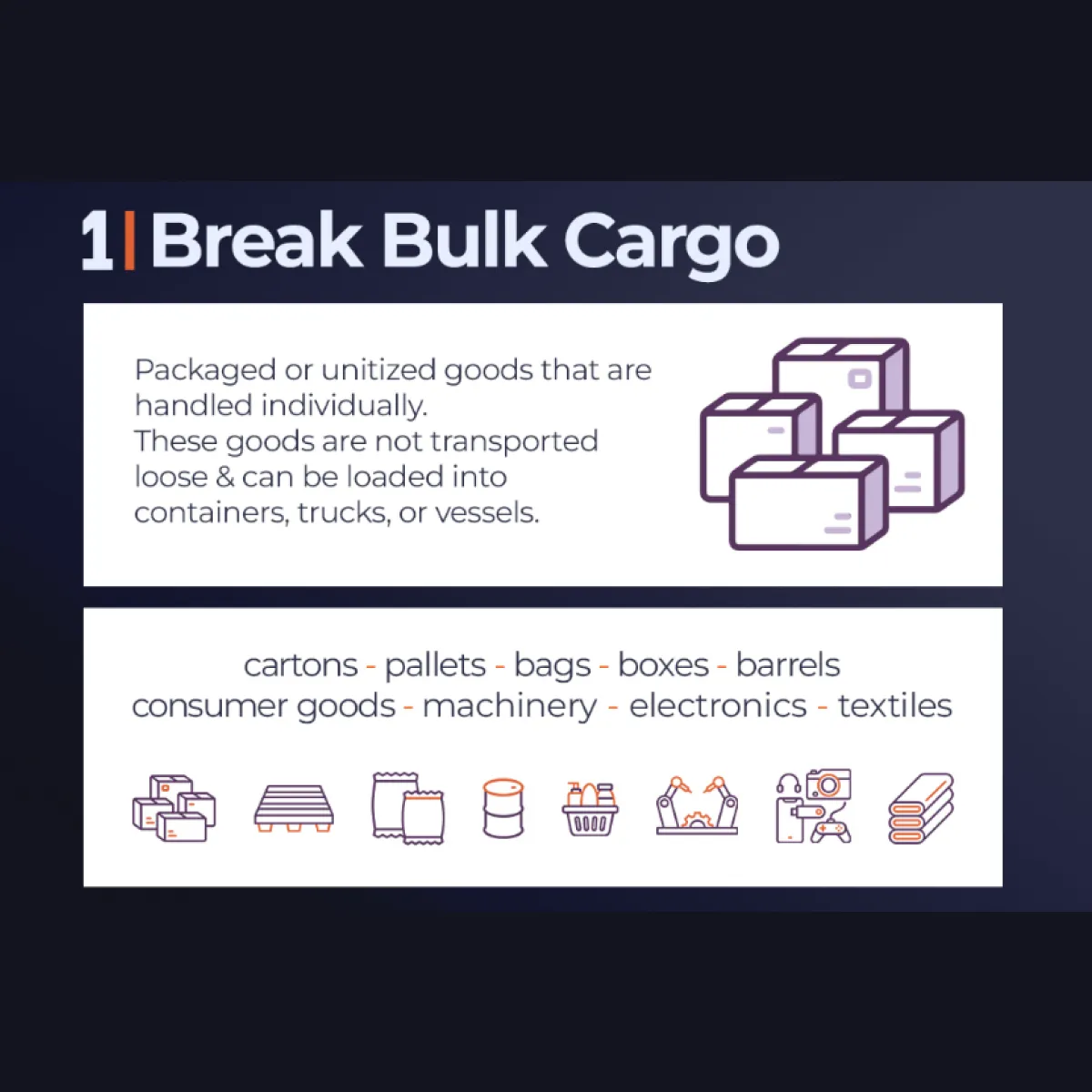
Break bulk cargo (also called general cargo) covers packaged or unitized goods that are handled and counted as cartons, sacks, bags, barrels, crates, and pallets. Unlike bulk cargo, break bulk items are not poured or loaded loose; unlike containerized cargo, they are not sealed inside a box container.
Typical goods
- Bagged goods such as rice, sugar, or cement in sacks
- Machinery parts, spare parts, and industrial equipment
- Textiles, consumer goods, and palletized electronics
- Steel coils, timber, and other neo-bulk items counted as units
How it is handled
Break bulk cargo is loaded and unloaded piece by piece, usually with cranes, forklifts, or conveyor systems. This makes it more labor-intensive than containerized cargo and generally slower to load.
But it remains the practical choice when goods are too large, too heavy, or too irregularly shaped for a standard container, or when container infrastructure is limited at the origin or destination, which is common at overland border crossings.
For more information: Breakbulk Cargo Transit Through Iran
2. Dry Bulk Cargo
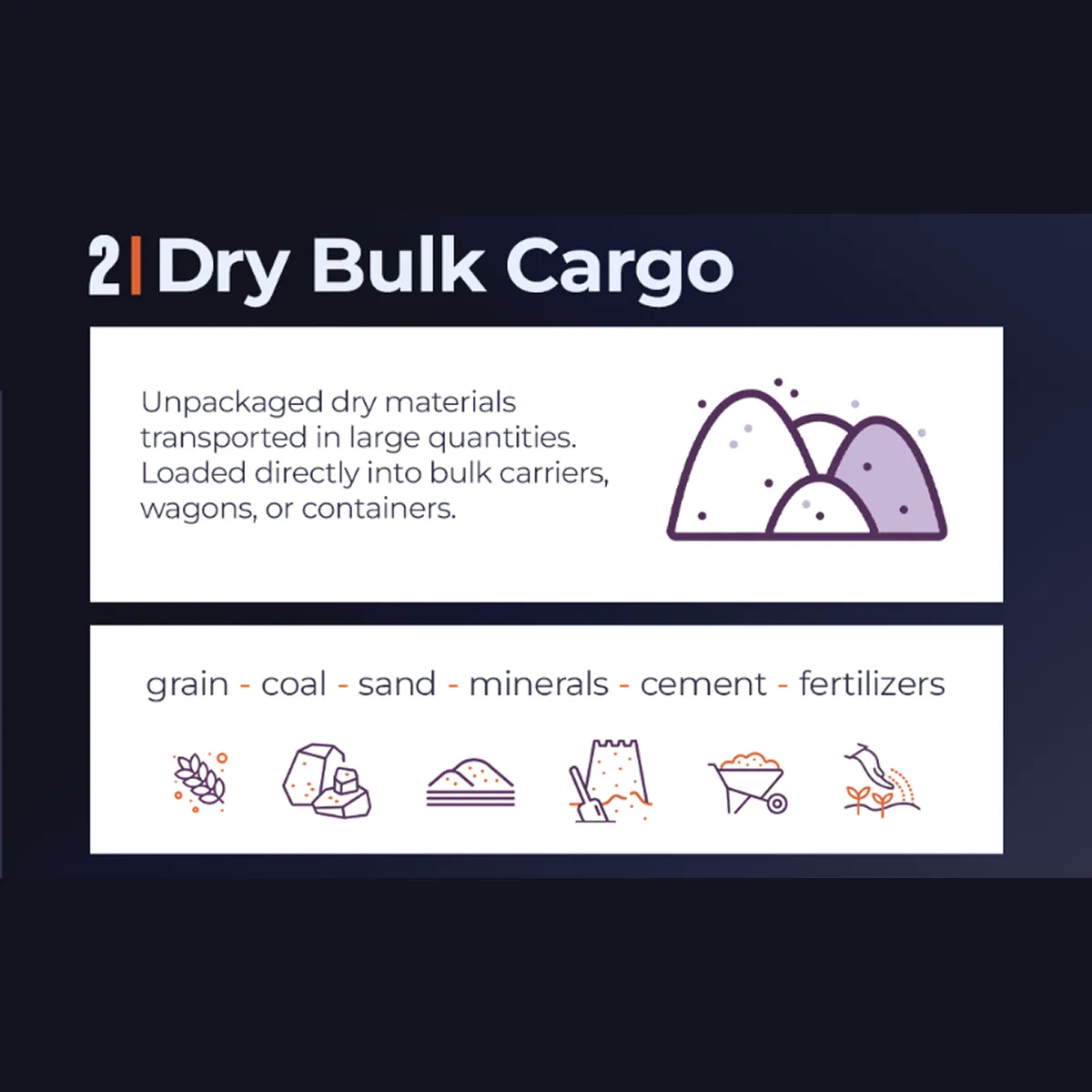
Dry bulk cargo refers to unpackaged solid materials transported loose in large quantities, poured, shoveled, or conveyed directly into a ship's hold, a rail hopper wagon, or a bulk truck trailer.
Typical goods
- Grain, rice, and other agricultural commodities
- Coal, iron ore, and other minerals
- Cement, sand, gravel, and fertilizers
How it is handled
Because dry bulk cargo has no individual packaging, handling relies on specialized equipment: grabs, conveyor belts, pneumatic loaders, and dedicated bulk carriers or hopper wagons.
Moisture control, contamination prevention, and accurate weight measurement are the main operational concerns, since pricing and customs valuation are based on tonnage.
For more information: Dry Cargo Transport from Iran
3. Liquid Bulk Cargo
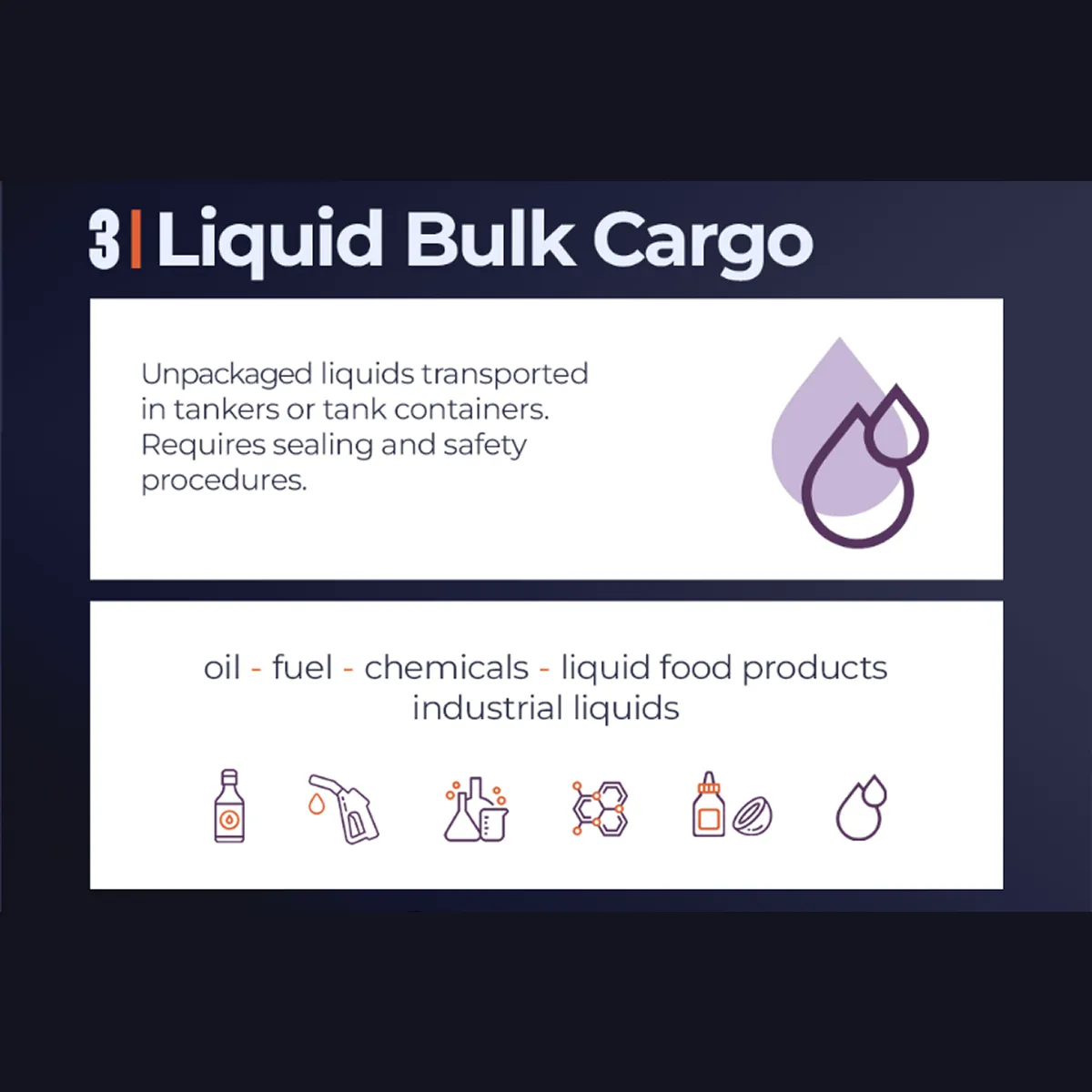
Liquid bulk cargo covers unpackaged liquids and gases moved in tankers, tank wagons, or ISO tank containers rather than in drums or bottles.
Typical goods
- Crude oil, refined fuel, and petrochemical products
- Industrial and agricultural chemicals
- Vegetable oils, molasses, and other liquid food products
- Liquefied gases, including LPG and LNG
How it is handled
Liquid bulk shipments require sealed, pressure- and temperature-rated equipment, along with strict spill-containment and cleaning procedures between loads. Many liquid bulk products are also classified as hazardous cargo, which adds a second layer of regulatory requirements on top of standard liquid-handling protocols.
For more information: Liquid Bulk Cargo Transport in Iran
4. Hazardous Cargo (Dangerous Goods)
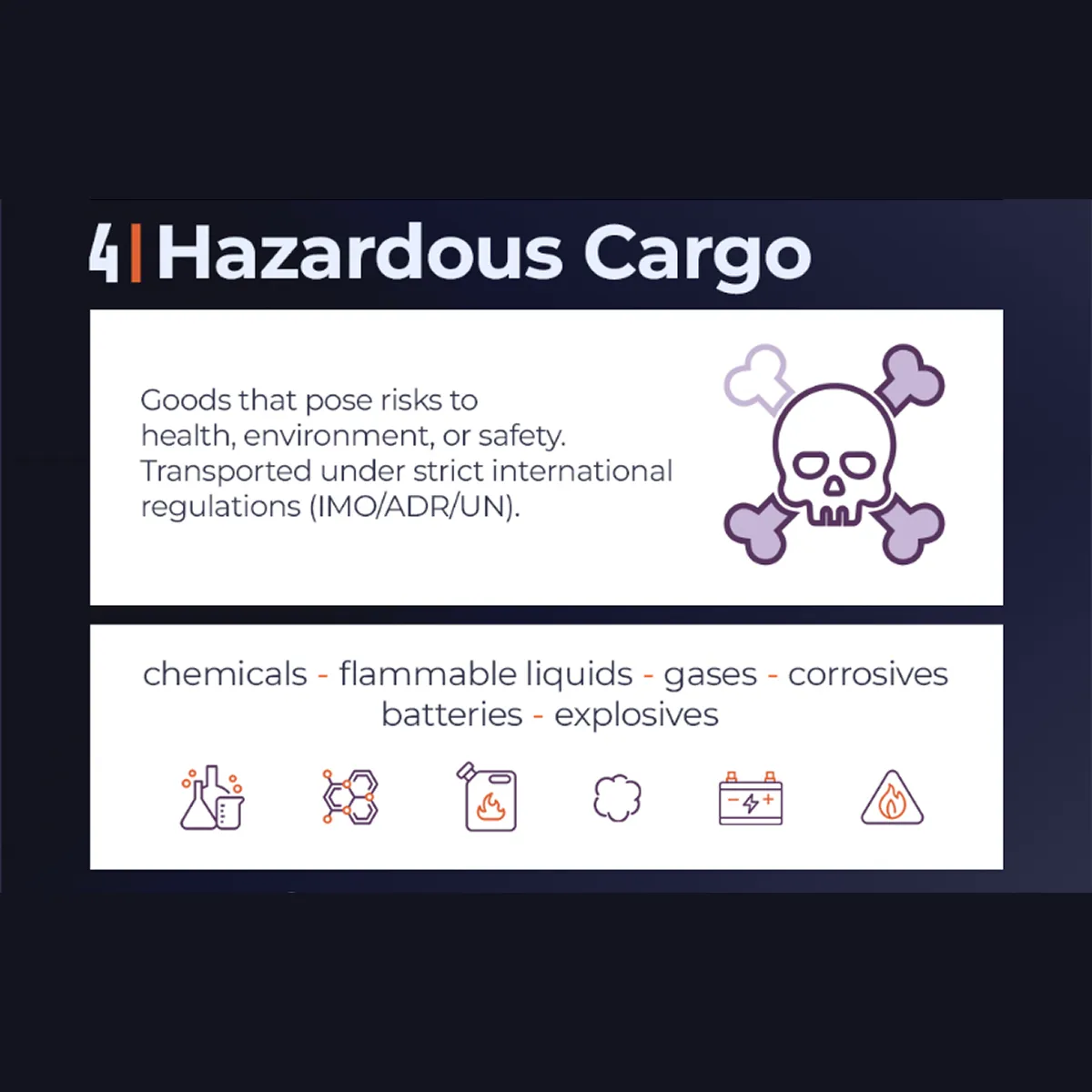
Hazardous cargo, also called dangerous goods (DG), includes any material that poses a risk to health, safety, property, or the environment during transport. This is the most tightly regulated cargo classification because a labeling or packaging mistake can put a vessel, aircraft, warehouse, or entire supply chain at risk.
International regulation is built on a shared United Nations framework, applied differently across transport modes: the IMDG Code for sea freight, ADR for international road transport, RID for rail, and the IATA Dangerous Goods Regulations for air freight.
All of them sort dangerous goods into the same nine UN hazard classes:
| Class | Hazard Category | Examples |
|---|---|---|
| 1 | Explosives | Fireworks, flares, ammunition |
| 2 | Gases | Flammable, non-flammable, or toxic gases (LPG, oxygen) |
| 3 | Flammable liquids | Fuel, paint, solvents |
| 4 | Flammable solids | Matches, certain metal powders |
| 5 | Oxidizers & organic peroxides | Bleach, fertilizers, some pool chemicals |
| 6 | Toxic & infectious substances | Pesticides, medical or lab samples |
| 7 | Radioactive material | Medical isotopes, industrial sources |
| 8 | Corrosives | Battery acid, industrial cleaning agents |
| 9 | Miscellaneous dangerous goods | Lithium batteries, dry ice, magnetized material |
Every dangerous goods shipment needs a UN number, a proper shipping name, correct hazard labels, a safety data sheet, and a certified DG-trained shipper or forwarder. Lithium batteries (Class 9) deserve special attention: they are now one of the most commonly misdeclared cargo types because they are packed inside everyday consumer electronics.
For more information: Dangerous Goods Shipping Through Iran
5. Perishable Cargo
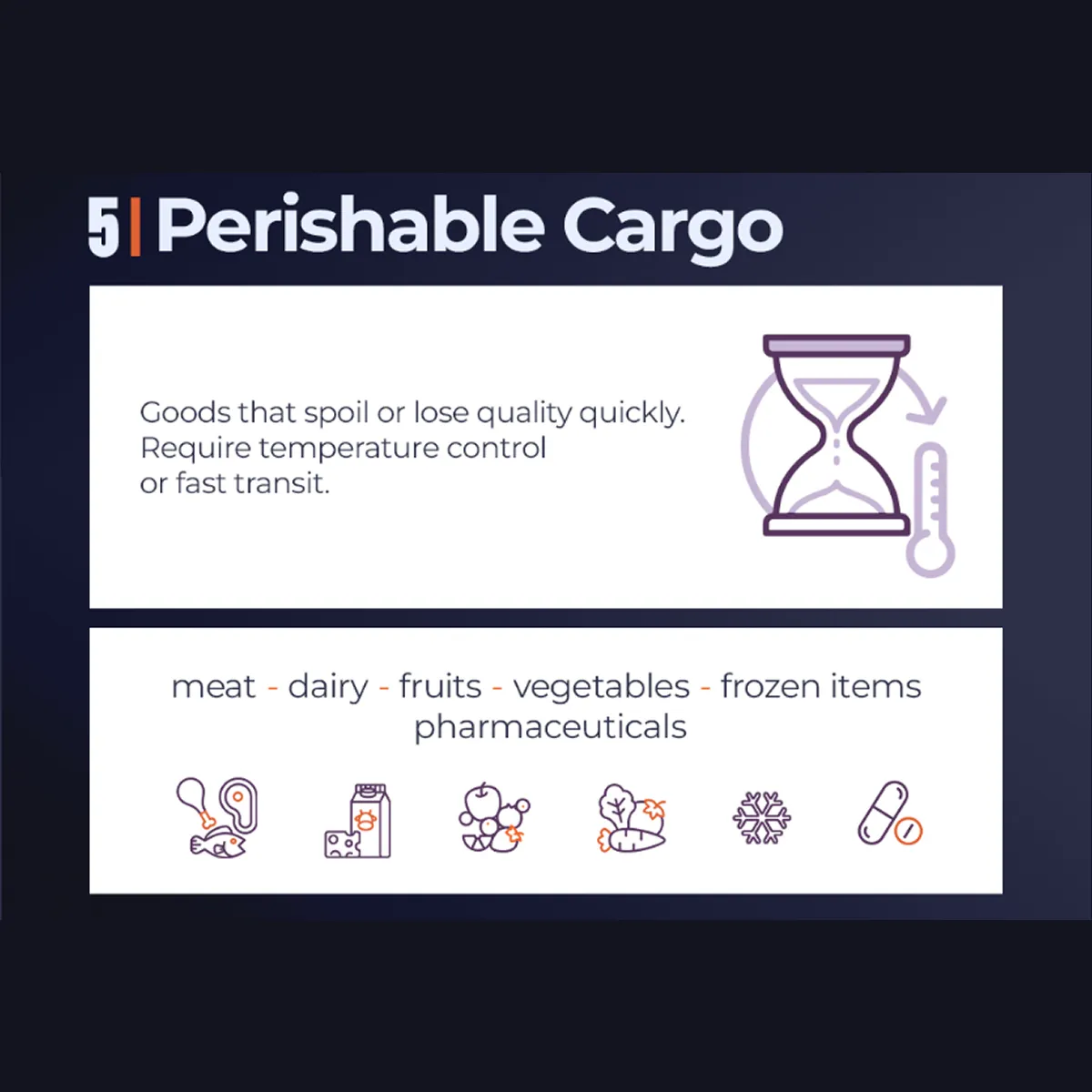
Perishable cargo covers goods that lose quality, freshness, or safety within a limited time unless they are kept within a controlled temperature and humidity range.
Typical goods
- Meat, seafood, and dairy products
- Fruit, vegetables, and cut flowers
- Frozen goods and ice cream
- Pharmaceuticals and vaccines requiring cold-chain storage
How it is handled
Perishable shipments move in refrigerated containers (reefers), insulated trucks, or temperature-controlled warehouses, with continuous monitoring from origin to destination.
The biggest risk is a break in the cold chain during transshipment, for example, when cargo is transferred between a vessel and a truck, or held at a border crossing. Phytosanitary certificates and health certificates are typically required for food and agricultural products.
6. High-Value Cargo
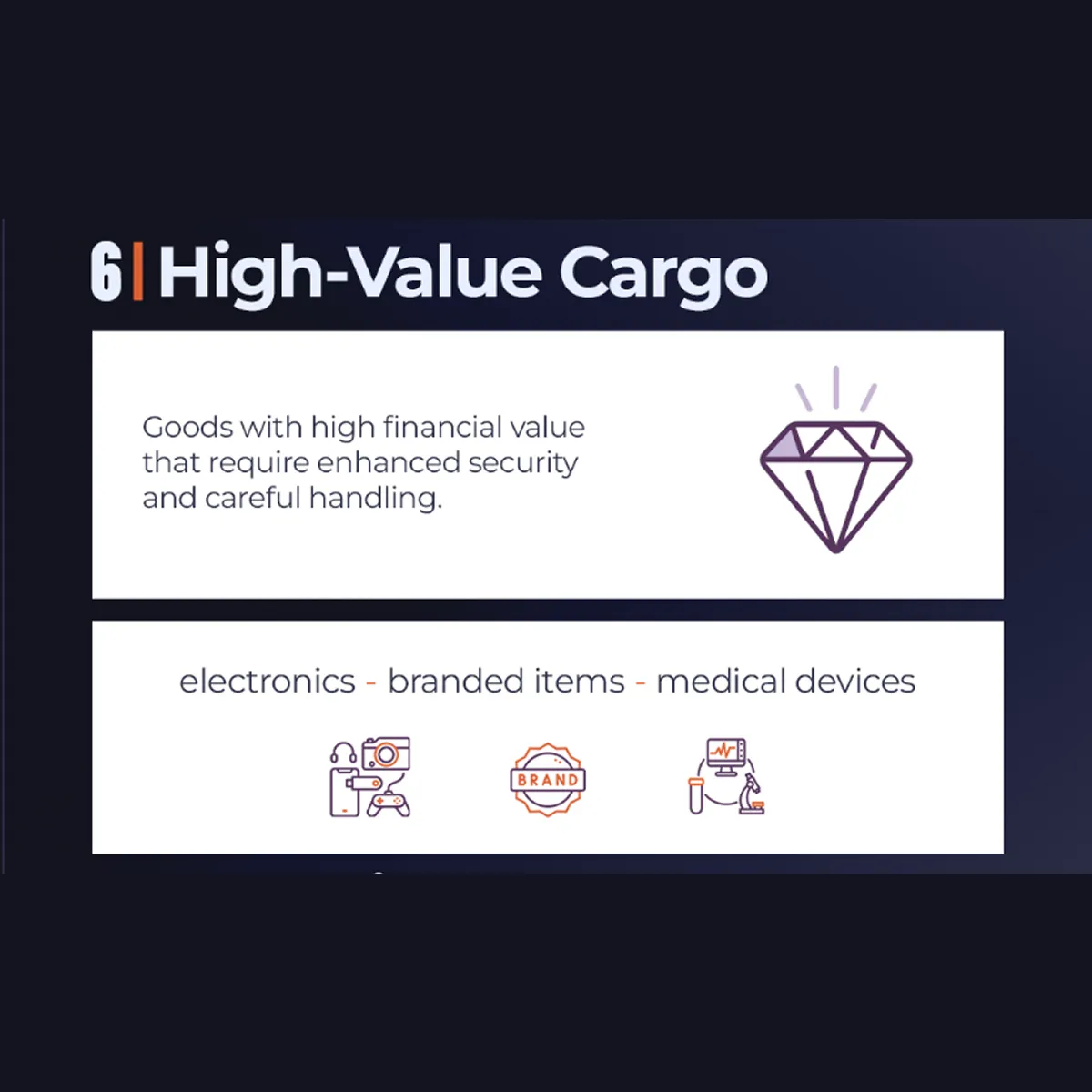
High-value cargo is defined by its financial value relative to its size and weight, not its physical form. The same shipment can also fit another classification; for instance, pharmaceuticals are often both perishable and high-value.
Typical goods
- Consumer electronics and branded products
- Medical devices and precision instruments
- Pharmaceuticals and specialty chemicals
How it is handled
High-value cargo requires enhanced security: sealed and GPS-tracked containers, restricted-access warehousing, careful documentation of custody at every handover, and cargo insurance sized to the shipment's real value rather than its weight.
7. Oversized Cargo (Project or Out-of-Gauge Cargo)
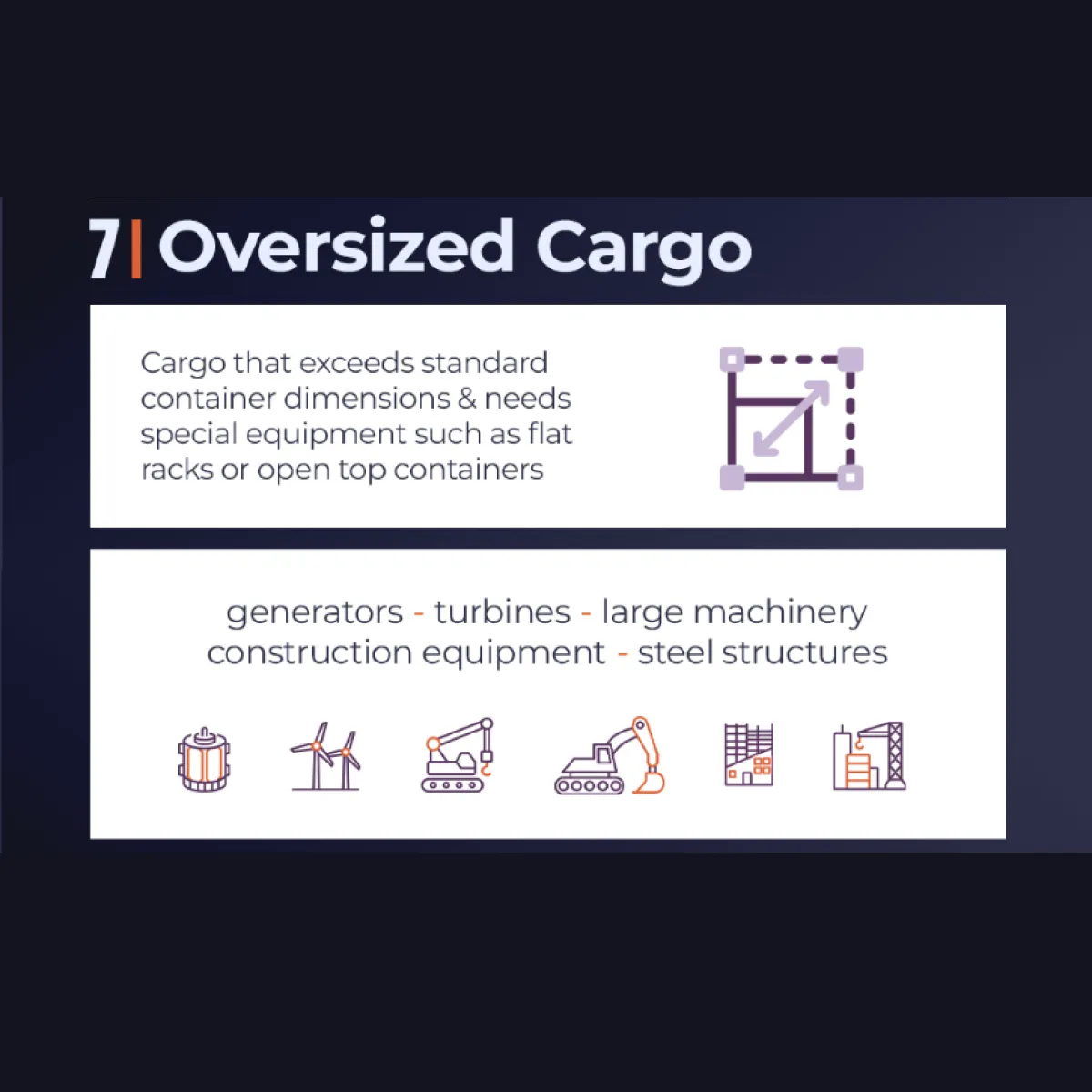
Oversized cargo, also called project cargo, heavy-lift cargo, or out-of-gauge (OOG) cargo, is any shipment that exceeds the dimensions or weight limits of a standard container.
Typical goods
- Turbines, generators, and transformers
- Construction and mining equipment
- Prefabricated steel structures and industrial modules
How it is handled
Oversized cargo needs flat-rack or open-top containers, multi-axle trailers, cranes, and a route survey to check bridges, tunnels, overhead cables, and road widths along the entire journey.
Because of this planning work, oversized shipments require longer lead times and, often, transport permits from every country the cargo passes through, a factor that matters directly for cargo transiting overland corridors.
Learn more: Bulk Cargo Transportation from Iran
How Cargo Classification Affects Mode and Route Selection
Classification is not just an administrative label; it is usually the single biggest factor in choosing how a shipment travels.
| Cargo Type | Common Transport Mode(s) | Key Consideration |
|---|---|---|
| Break bulk | General cargo vessel, truck, rail | Labor-intensive loading; flexible for odd shapes |
| Dry bulk | Bulk carrier, hopper wagon, bulk truck | Specialized loading equipment; weight-based pricing |
| Liquid bulk | Tanker, ISO tank container, pipeline | Sealing, cleaning, and spill-control requirements |
| Containerized | Container vessel, rail, truck (intermodal) | Fastest to transfer between transport modes |
| Hazardous | Mode depends on DG class and approvals | Certified handling, labeling, and documentation |
| Perishable | Reefer vessel/truck, air freight for urgent loads | Unbroken cold chain; fast transit |
| High-value | Air freight or secured ocean/road transport | Security and insurance over pure cost |
| Oversized | Flat-rack/open-top container, heavy-haul trailer | Route survey and permits before departure |
Cargo Classification and Transit Through Iran
Iran's position between the Persian Gulf, the Caucasus, and Central Asia makes it a natural transit corridor for cargo moving between the UAE, India, China, Turkey, and CIS countries such as Uzbekistan and Turkmenistan, as well as Afghanistan and Pakistan.
But the classification of a shipment still drives every decision along that route.
- Dry and liquid bulk cargo generally needs port or rail infrastructure suited to loose-load handling at the entry and exit points of the corridor.
- Hazardous and perishable cargo needs pre-cleared permits, correct labeling in the required languages, and, for perishables, unbroken cold-chain continuity across every handover between road, rail, and port.
- High-value and oversized cargo benefit most from a forwarder with border representatives who can track custody and coordinate specialized equipment at each crossing.
Because regional routing conditions can change, the specific ports and border crossings available for a given cargo classification should always be confirmed with a transit specialist at the time of booking.
Rasta Nik Asia coordinates classification-appropriate handling, documentation, and equipment across Iran's border points, land routes, and multimodal connections, so that the right cargo type reaches the right corridor with the right paperwork the first time.
You need to move specialized cargo through Iran with fewer delays and documentation risks? Talk to Rasta Nik Asia to identify the right route, handling requirements, and transit solution for your shipment.
How to Determine the Correct Classification for Your Shipment
- Identify the physical state of the goods (solid, liquid, or gas) as your starting point.
- Check the HS code and any regulatory triggers it carries, such as dangerous goods, food safety, or phytosanitary rules.
- Assess the shipment's value relative to its size to decide whether high-value handling is needed.
- Compare the cargo's dimensions and weight against standard container limits to identify oversized cargo early.
- Confirm time-sensitive, perishable, or urgent cargo may justify a faster, more expensive mode.
- Involve your freight forwarder before booking, not after, so equipment and documentation match the classification from the start.
Common Mistakes in Cargo Classification
- Misdeclaring lithium batteries or other Class 9 goods as ordinary general cargo, which leads to rejected bookings or fines.
- Underestimating oversized cargo planning and skipping a route survey, resulting in delays at bridges or narrow border roads.
- Breaking the cold chain for perishable cargo during transshipment between vessel, rail, and truck.
- Assuming a single classification for mixed shipments: a container can hold both general and high-value cargo, each needing its own handling notes.
- Choosing a mode of transport based on cost alone without checking whether the classification allows it; some hazardous goods, for example, cannot travel by certain routes or modes at all.
Conclusion
Cargo classification is the foundation of every international shipment. Whether your goods are dry bulk grain, hazardous chemicals, temperature-sensitive pharmaceuticals, or an oversized industrial machine, getting the classification right from the start determines the equipment, documentation, and route your cargo will need.
For traders and businesses moving cargo through Iran's ports, borders, and multimodal corridors, working with a forwarder who understands these classifications in practice makes the difference between a smooth transit and a costly delay.
Rasta Nik Asia's network across Iran's borders and its experience coordinating every cargo type, from break bulk to hazardous and oversized shipments, means your cargo is matched with the right handling from day one.
Ready to move your next shipment through Iran? Contact Rasta Nik Asia for a tailored freight consultation and quote.
Resources
7 Common Types of Cargo in International Shipping